Small and fast to build
A release app is a few MB. The build cache is hundreds of MB, not gigabytes, and Zig rebuilds incrementally.
Zig 0.16 · Linux · Windows · macOS · Android · iOS
Oriel gives your React, Vue, Svelte or plain HTML frontend a native app on desktop and mobile, with typed Zig commands to call. Use the system WebView or try the experimental native renderer with the same web files. One codebase, five platforms.
curl -fsSL https://raw.githubusercontent.com/highercomve/Oriel/main/install.sh | sh
curl -fsSL https://raw.githubusercontent.com/highercomve/Oriel/main/install.sh | sh
irm https://raw.githubusercontent.com/highercomve/Oriel/main/install.ps1 | iex
Everything a desktop app needs, compiled in only when you ask for it.
A release app is a few MB. The build cache is hundreds of MB, not gigabytes, and Zig rebuilds incrementally.
Write Commands and Events as plain Zig structs. invoke and listen are generated for TypeScript at compile time.
Navigation limits, per-origin command capabilities, a strict CSP, and a bridge injected only into your own pages.
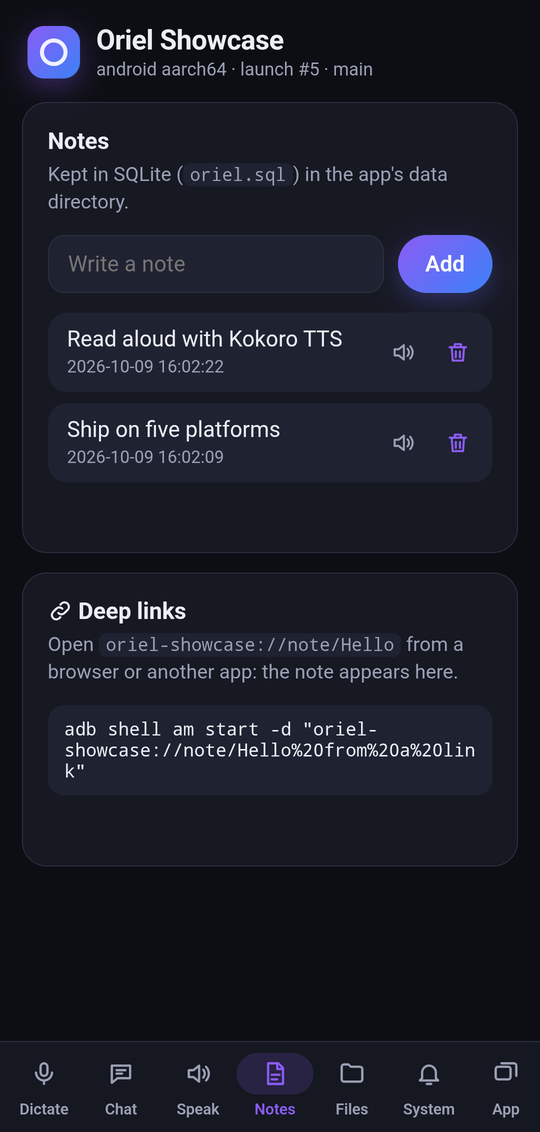
Tray, updater, SQLite and sqlite-vec, offline text to speech, the phone's own model, camera, lifecycle events, dialogs, notifications, global shortcuts, clipboard, file watching, deep links, audio capture, media server.
llama.cpp and whisper.cpp as modules: CUDA, Vulkan and Metal on the desktop, Metal on iOS, and ARM dotprod/i8mm CPU kernels, Vulkan, OpenCL and Hexagon on Android.
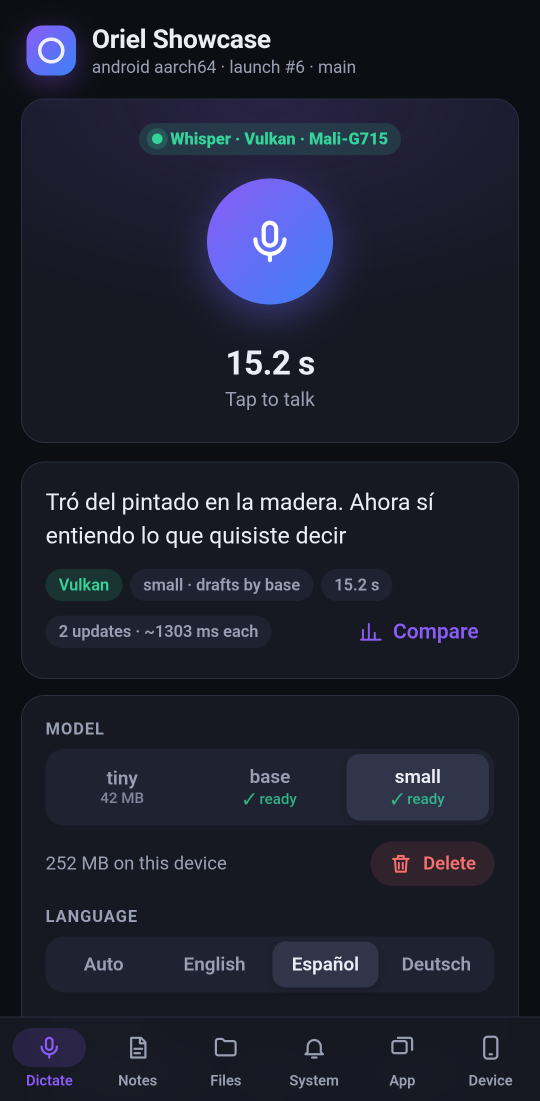
oriel.dictation: live dictation and file transcription out of the box. Whisper with voice detection, live draft text and a measured CPU or GPU per device, or the phone's own recognizer.
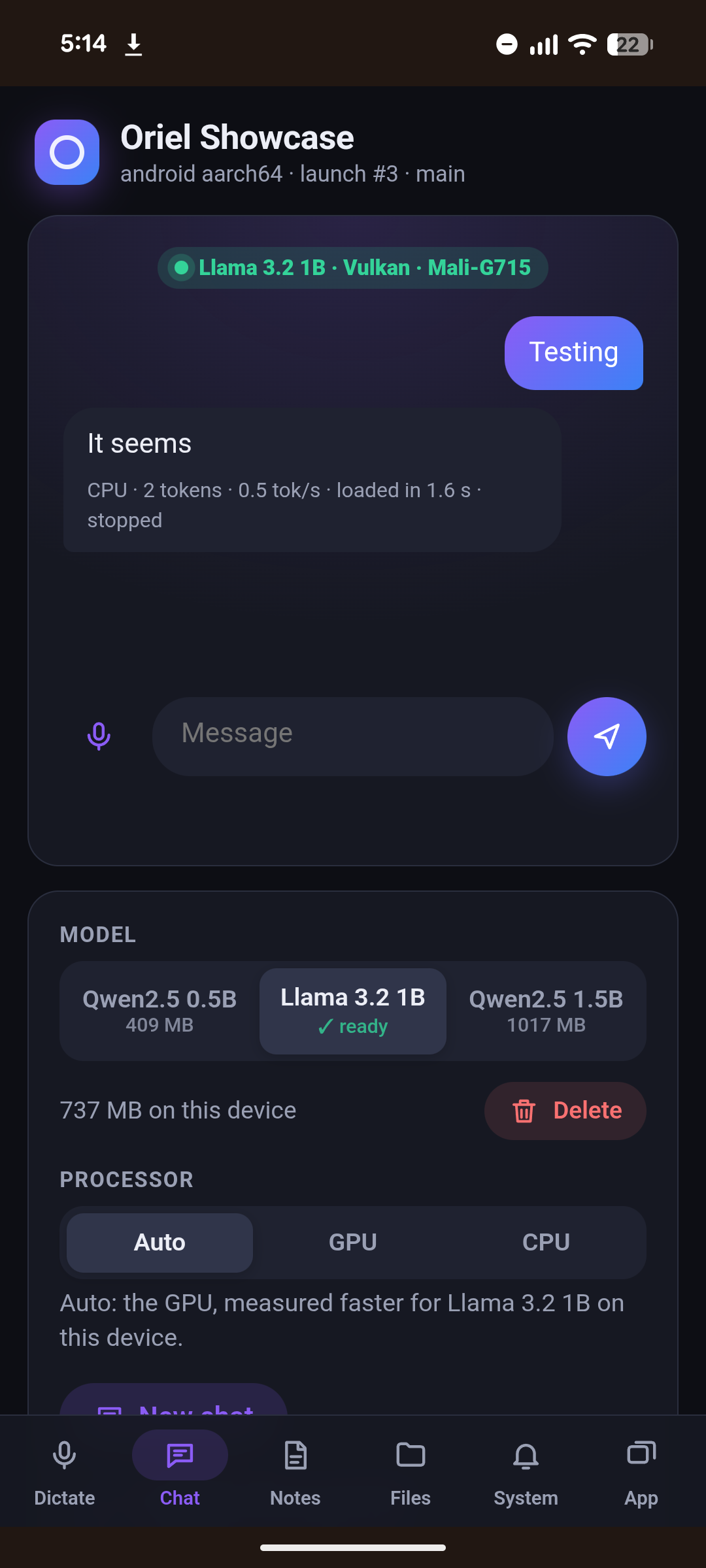
oriel.chat is a local LLM in a module: models, the chat template, streamed tokens and a reused KV cache, on the CPU or the GPU, per device.
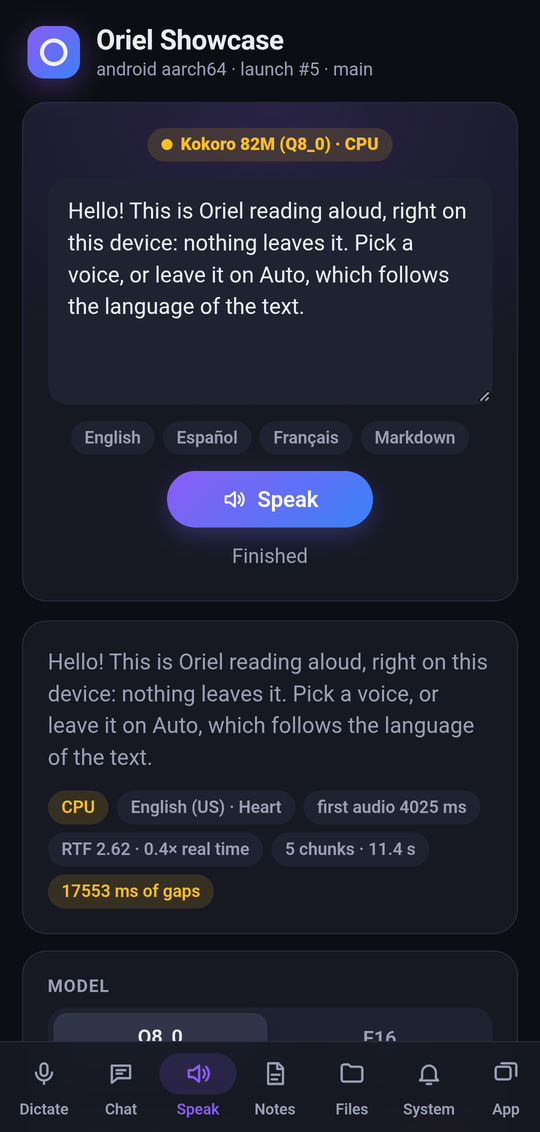
oriel.tts: Kokoro-82M text to speech out of the box. Verified voice downloads, bundled phoneme data, and streaming playback on the CPU or GPU.
oriel.speakers: speaker embeddings and diarization, offline. Voices clustered into speakers over a recording, and matched against the voices an app remembers.
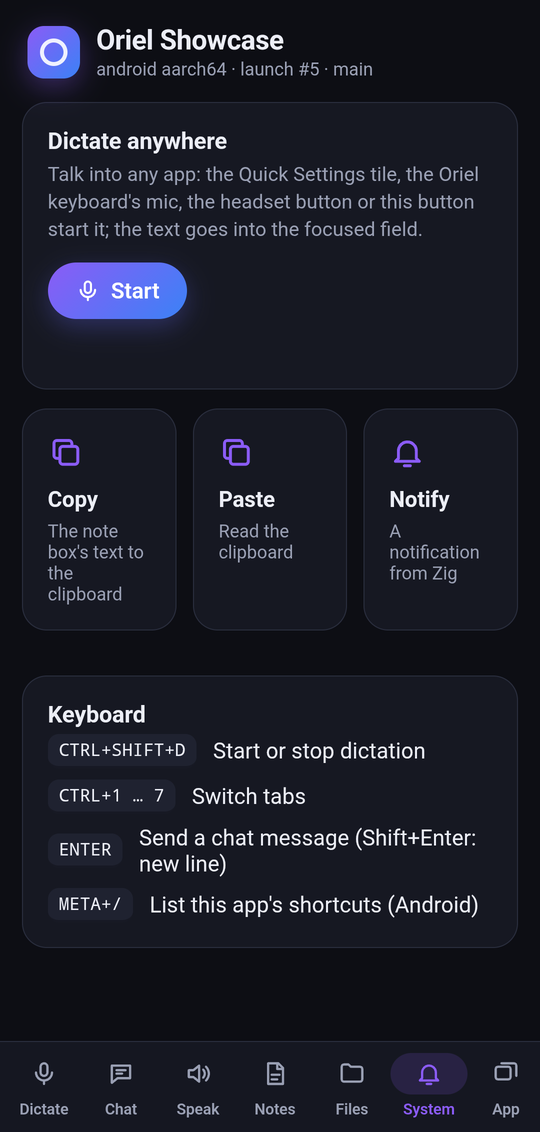
The same app on Android (phones, desktop mode, ChromeOS) and iOS. Tiles, a keyboard, notification actions and deep links stand in for the tray and hotkeys.
System-wide hotkeys, typing and pasting into other apps, image clipboard, and microphone or system audio capture, on X11, Wayland, Windows and macOS.
oriel.updater checks Ed25519-signed manifests, swaps the binary, AppImage or .app atomically and restarts in place on Linux, Windows and macOS. The page can't change the URL or the key.
oriel.network announces and finds services on the local network with mDNS/DNS-SD, through each platform's own responder; oriel.bluetooth sends a Bluetooth LE beacon nearby phones see. No server in between.
App extensions: your Kotlin, Swift, Objective-C or Zig, declared by name in build.zig and called with one API on every platform, from Zig or the page.
oriel package builds deb, rpm, AppImage, .dmg and Windows setup.exe (natively or cross-compiled from Linux); oriel android build an APK and AAB; oriel ios build an .ipa.
Render your frontend with native views using the experimental, opt-in native UI renderer.
-Dnative_ui runs the same HTML, CSS and JavaScript with QuickJS, a DOM written in Zig and platform drawing on Linux, Windows, macOS, Android and iOS. React, Vue, Svelte, Preact and CSS-in-JS apps run on it.
Mixed-font lines, baseline alignment, decorated inline text and styled SVGs. Android text widths and control sizes follow its WebView; macOS buttons keep their default AppKit appearance until styled.
Breakout runs either way, in both renderers. Numeric canvas recording and transform updates reduce work per frame; the render bench covers rows, animation, canvas and memory on Android and desktop. Battery savings have not been established.
The native renderer is experimental; accessibility, full CSS grid and shadow DOM remain incomplete. See the release changelog for details.
A pub fn in Commands is callable from the page. Its arguments and return type become the TypeScript types.
pub const Commands = struct {
    /// invoke("greet", { name })
    pub fn greet(gpa: std.mem.Allocator, args: struct {
        name: []const u8,
    }) ![]const u8 {
        events.emit(.greeted, .{ .count = 1 });
        return std.fmt.allocPrint(gpa,
            "Hello, {s}!", .{args.name});
    }
};import { invoke, listen } from "./oriel";
// Typed from the Zig structs: name is a string,
// the result is Promise<string>.
const text = await invoke("greet", { name: "Ada" });
listen("greeted", ({ count }) => {
console.log(`greeted ${count} times`);
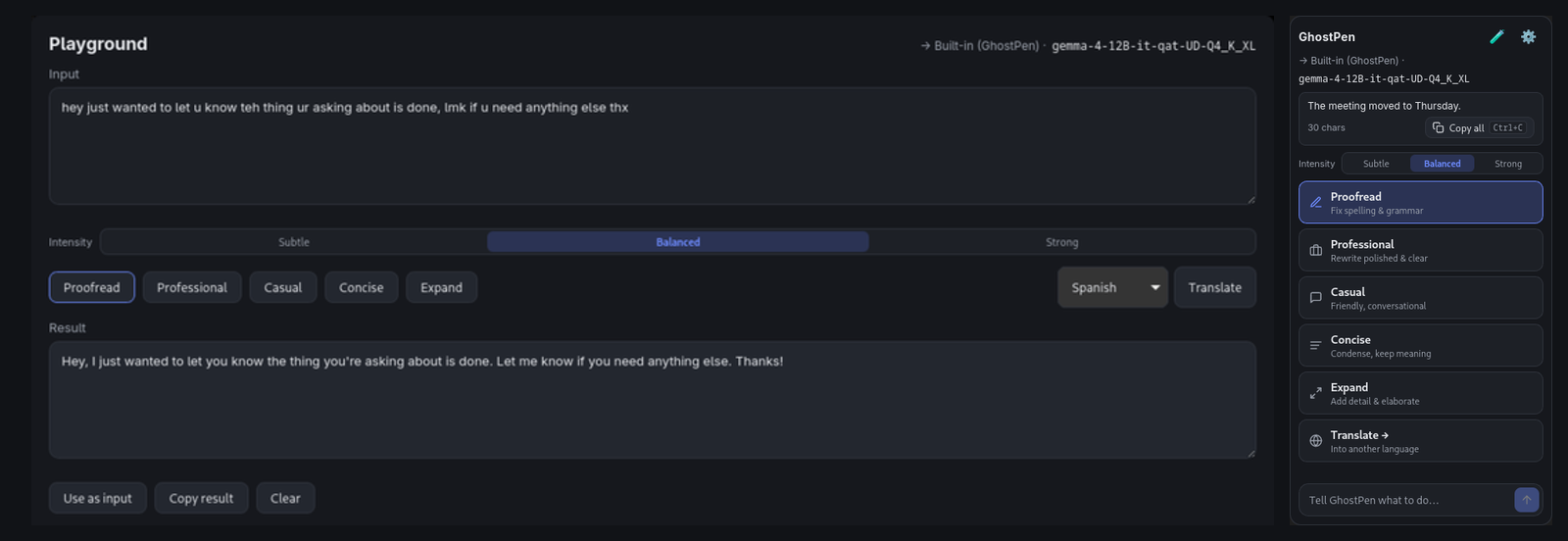
});GhostPen: AI text editing anywhere on the desktop, ported from Tauri. Built-in models (llama.cpp), live captions and dictation (whisper.cpp) on the GPU (Vulkan, CUDA, Metal), and meetings with speakers by voice (oriel.speakers), on Linux, Windows and macOS.
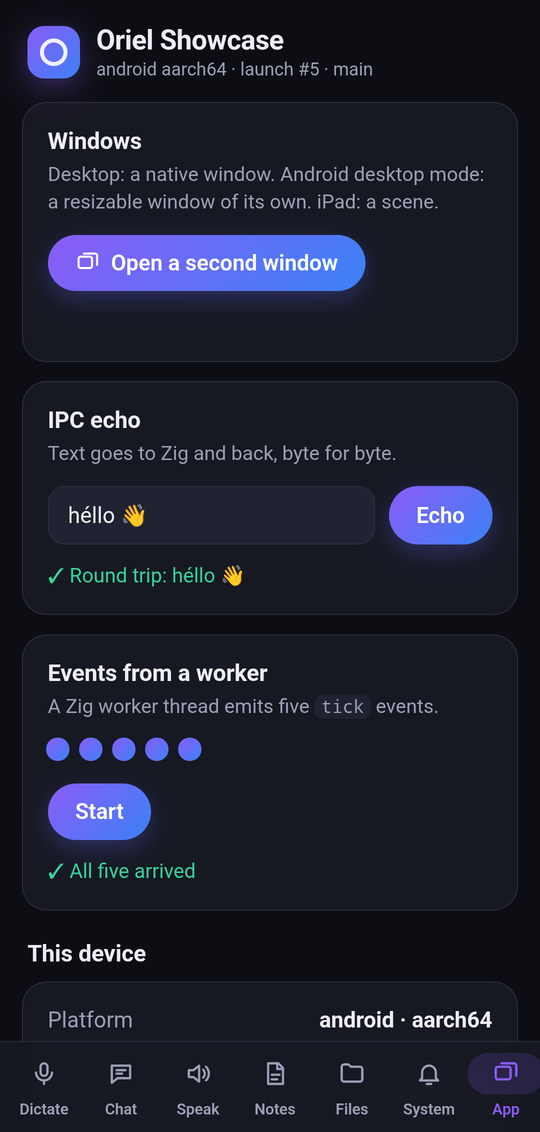
examples/showcase: every Oriel feature in one app, from one codebase, for Linux, Windows, macOS, Android and iOS. Below, on Android: Dictate and Chat on a Pixel, the rest on a Poco X3.
examples/system-monitor: a live CPU, memory, disk, network and process monitor that reads the kernel directly and spawns nothing, on Linux, Windows and macOS.
.oriel views with no JavaScript runtime (the default), the native renderer, or the WebVieworiel.updater, signed and verified.app with every release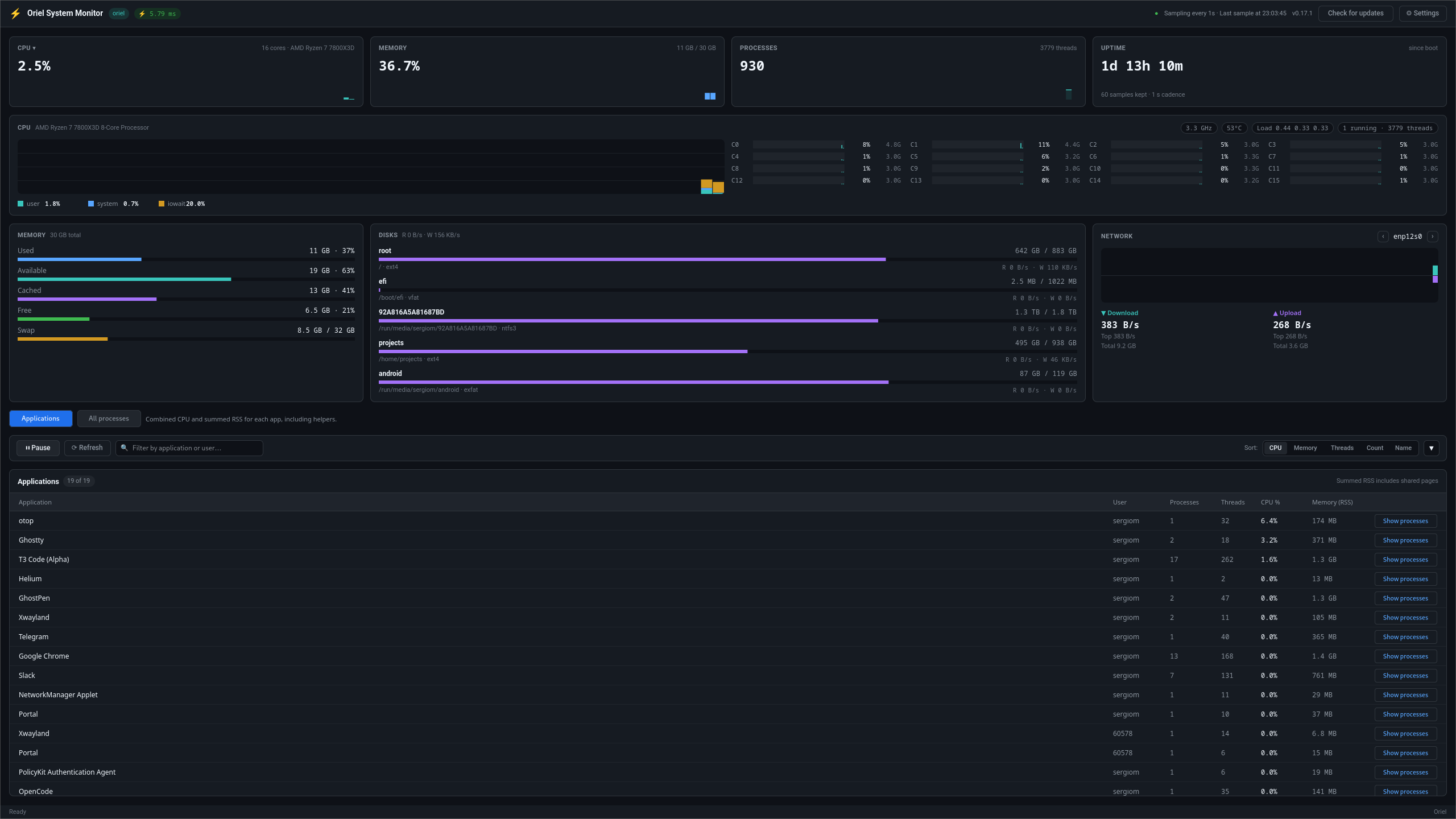
examples/breakout: a canvas game with an HTML and CSS interface, in the WebView or the native renderer. Drag on a phone; mouse or arrow keys on the desktop.
oriel.canvas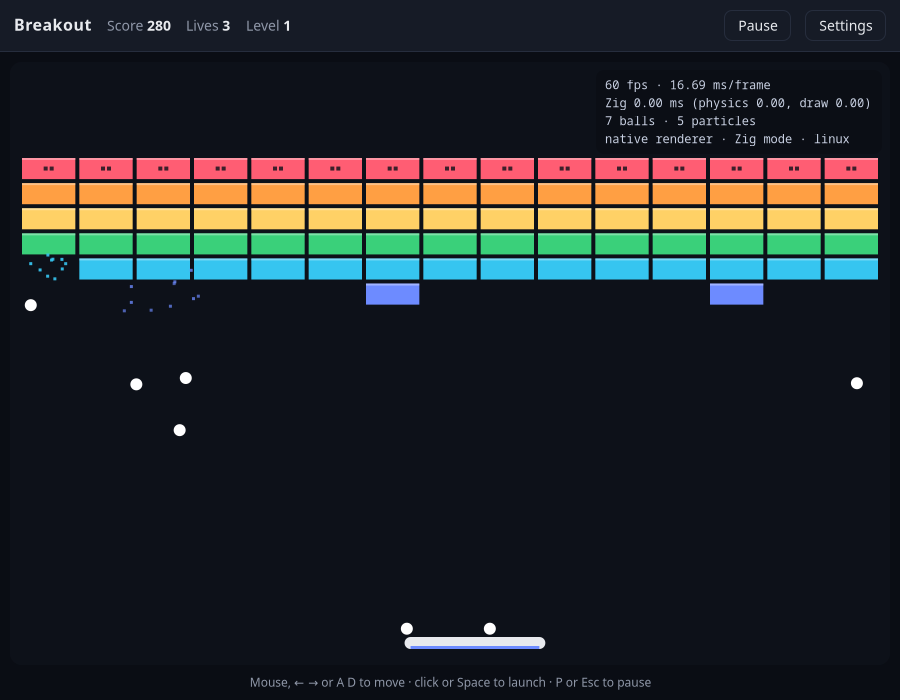
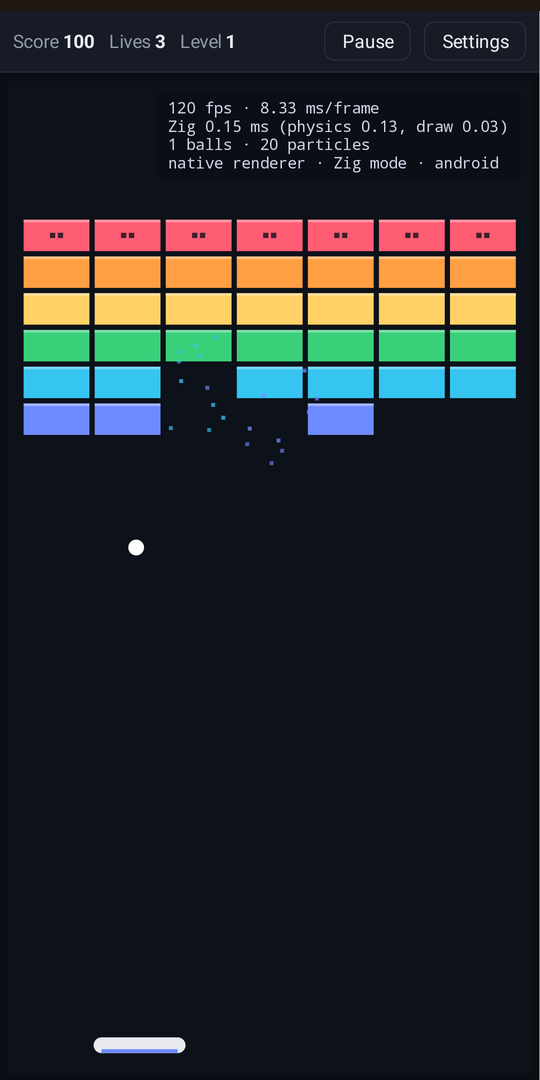
GTK4 + WebKitGTK 6.0. Complete: every module, deb / rpm / AppImage.
StableWin32 + WebView2. Every module ported, verified on real Windows 11. Build natively or cross-compile from Linux; per-user NSIS installer.
VerifiedAppKit + WKWebView. Every module ported, Metal for whisper / llama, deep links, .app / .dmg packaging. Verified on macOS 15, Apple Silicon.
Kotlin shell + WebView over JNI, one window per Activity (resizable in desktop mode). APK and AAB. Verified on a Pixel phone, Android desktop mode and the emulator.
VerifiedUIKit + WKWebView from Zig, no Xcode project. .app and .ipa, Metal for whisper / llama. The showcase verified in the iPhone simulator (iOS 18): commands, events, workers, local chat, a second window. Real devices next.
The same model: a web frontend, a native backend, calls between them. What changes is what ships with your app.
| Electron | Tauri | Oriel | |
|---|---|---|---|
| Backend | JavaScript on Node.js | Rust | Zig 0.16 |
| UI | Chromium, bundled with every app | The system webview | The system webview, or native views with no webview (native renderer, compiled .oriel views) |
| App size | Chromium and Node.js in every app | Small: no browser bundled | A few MB: no browser bundled |
| UI ↔ backend | ipcMain / ipcRenderer through a preload script | invoke commands and events | Plain Zig structs; TypeScript generated at compile time; sync and async worker pool |
| Mobile | Desktop only | Android and iOS | Android and iOS from the same Zig and web code |
| Local AI and voice | Packages you add | Plugins or crates you add | Built in: llama.cpp, whisper.cpp, Kokoro text to speech, speaker diarization |
| Updates | autoUpdater or electron-updater | Updater plugin, signed | Ed25519-signed manifests, atomic replace, progress events |
| Packages | Electron Forge or electron-builder | The Tauri bundler | oriel package: deb, rpm, AppImage, .dmg, setup.exe; APK, AAB and .ipa |
| Toolchain | Node.js and npm | Rust and Cargo: multi-GB target directories | Zig: a build cache in hundreds of MB, incremental rebuilds |
| Tauri | Oriel |
|---|---|
invoke / commands | Plain Zig struct; TypeScript generated; sync and async worker pool |
Events (emit / listen) | Zig → JS, type-checked on both sides; targeted and broadcast |
| Capabilities | Per origin, per command, per window |
| Multiple windows | oriel.window.open() from JS, routes, targeted events |
create-tauri-app, tauri dev/build | oriel init (React, Vue, Svelte, vanilla), oriel dev/build/package, oriel doctor |
Install the CLI, run oriel init my-app, and you have a window with hot reload in a minute.